
Training
How to Train Your VO₂max?
How structured intervals can improve VO₂max and endurance performance.

Can VO₂max Be Improved?
In the previous article, we looked at what VO₂max is, how the body delivers and uses oxygen, and why it is important for endurance performance. If you have not read that article yet, you can read it first here: What Is VO₂max?
Now that we understand what VO₂max represents, the next question is: can we improve it through training, and how can we do it?
VO₂max can be improved through training. One effective way to improve it is high-intensity interval training (HIIT), in which periods of high-intensity exercise are alternated with periods of easier effort or recovery.
A recent systematic review and meta-analysis conducted by Qi, Tan, Xu, Xu, Kawczyński, and Chen (2026) included 18 studies involving trained athletes, with a total of 518 athletes from different sports and training levels. For the VO₂max analysis specifically, 10 studies involving 293 participants were included. The authors found that HIIT produced significantly greater improvements in VO₂max compared with control or non-HIIT training.
Why Do Intervals Work?
During very high-intensity exercise, the muscles require a large amount of oxygen. However, it is difficult to maintain such a high intensity continuously for a long period of time. Interval training therefore allows high intensity to be divided into several shorter efforts, with periods of recovery in between. This makes it possible to repeatedly reach a very high intensity throughout the workout without having to maintain maximal effort continuously.
The goal of VO₂max training is therefore not to perform every interval all-out. If every interval were started with maximal effort, fatigue would build up quickly and it would become difficult to maintain the required intensity throughout the entire workout. The goal is to choose an intensity that places a high demand on the cardiovascular and aerobic systems while still allowing you to complete all intervals with good quality.
What Does a VO₂max Workout Look Like?
There are many different ways to structure a VO₂max workout. In cycling, intervals lasting approximately 3–6 minutes are commonly used at a very high intensity. One of the best-known examples is:
4 × 4 min
4 min at approximately 110–120% FTP, or at an intensity that brings your heart rate to approximately 90–95% of maximum heart rate toward the end of the interval
4 min of easy recovery
Repeat 4 times
The perceived effort during this type of workout is approximately 8/10. It is important to understand that heart rate does not rise immediately at the beginning of an interval because of the delayed cardiovascular response to exercise intensity. Therefore, it is not necessary to try to reach 90–95% of maximum heart rate within the first few seconds. During longer intervals, heart rate gradually increases and may reach or exceed 90% of maximum heart rate toward the end of the interval.
In a classic study, Helgerud et al. (2007) found that 4 × 4-minute intervals performed at approximately 90–95% of maximum heart rate improved VO₂max by approximately 7.2% over eight weeks in moderately trained men. High-intensity interval training produced greater improvements in VO₂max than lactate-threshold training and prolonged training at lower intensity.
However, 4 × 4 minutes is not the only way to train VO₂max. Intervals can be approximately 3–6 minutes long, and different work-to-recovery ratios can be used. Therefore, there is no single “perfect” protocol.
What matters most is that the intensity is high enough to place a strong demand on the aerobic system, but not so high that starting too hard causes the quality of the intervals to decline substantially toward the end of the workout.
Practical Example
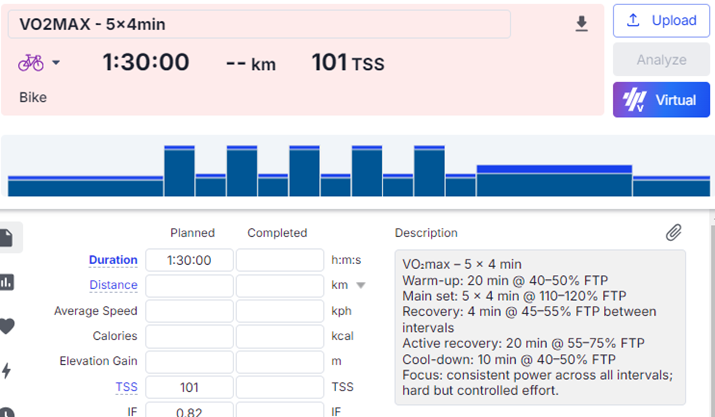
A practical example of a cycling VO₂max workout: 5 × 4 minutes at 110–120% FTP, with 4 minutes of easy recovery between intervals. The goal is to maintain a high but controlled intensity throughout all intervals.
Important
VO₂max training is only one part of overall endurance training. Most endurance training is not made up of very high-intensity intervals. How often VO₂max training should be included depends on training status, overall training load, recovery, and the phase of training.
VO₂max can be improved through structured training, with high-intensity interval training being one of the well-researched methods. 4 × 4 minutes is one well-researched example, but it is not the only effective protocol. Intervals can vary in duration, intensity, and recovery periods, with the key being the ability to maintain high intensity with good quality throughout the workout.
References
- 1. Qi, K., Tan, L., Xu, Q., Xu, Y., Kawczyński, A., & Chen, A. (2026). Effects of high-intensity interval training on aerobic capacity and athletic performance in trained athletes: a systematic review and meta-analysis. BMC Sports Science, Medicine and Rehabilitation, 18, 41. https://doi.org/10.1186/s13102-025-01479-7
- 2. Helgerud, J., Høydal, K., Wang, E., Karlsen, T., Berg, P., Bjerkaas, M., et al. (2007). Aerobic high-intensity intervals improve VO₂max more than moderate training. Medicine & Science in Sports & Exercise, 39(4), 665–671. https://doi.org/10.1249/mss.0b013e3180304570
- 3. de Oliveira-Nunes, S. G., Castro, A., Sardeli, A. V., Cavaglieri, C. R., & Chacon-Mikahil, M. P. T. (2021). HIIT vs. SIT: What Is the Better to Improve VO₂max? A Systematic Review and Meta-Analysis. International Journal of Environmental Research and Public Health, 18(24), 13120. https://doi.org/10.3390/ijerph182413120
- 4. Helgerud, J., Hov, H., Mehus, H., Balto, B., Boye, A., Finsås, L., Hoff, J., & Wang, E. (2023). Aerobic high-intensity intervals improve O₂max more than supramaximal sprint intervals in females, similar to males. Scandinavian Journal of Medicine & Science in Sports, 33(11), 2193–2207. https://doi.org/10.1111/sms.14470