
Sports Nutrition
Do You Really Need Carbohydrates During Shorter Rides?
What the evidence says about carbs on rides under 75 minutes.

Besides macronutrient intake before exercise, adequate carbohydrate intake during exercise is also important for maintaining performance, particularly during longer and more intense activities. Consuming carbohydrates during exercise provides an exogenous source of energy that supports muscle and central nervous system function and helps prevent the depletion of glycogen stores. However, this raises an important question: is carbohydrate intake really necessary during shorter activities?
In cycling among younger age groups, where races can last anywhere from 30 minutes to 1 hour, we often see riders reaching for gels and other carbohydrate sources during the race. But is this actually necessary? The answer is not always straightforward.
When pre-exercise nutrition is adequate, there is generally no need to consume additional carbohydrates during shorter cycling events. Current recommendations suggest that for exercise or competition lasting up to 90 minutes, athletes should consume approximately 6–12 g of carbohydrates per kilogram of body mass in the 24 hours before the event. For an additional carbohydrate boost, around 1–4 hours before exercise, approximately 1–4 g of carbohydrates per kilogram of body mass can be consumed. During the final hour before exercise, a small carbohydrate-rich snack may also be useful, preferably in liquid form if solid foods cause gastrointestinal discomfort.
For shorter rides or races lasting up to approximately 45 minutes, carbohydrate intake during exercise is therefore generally not necessary when adequate pre-exercise nutrition has been consumed. During somewhat longer and more intense exercise lasting approximately 45–75 minutes, small amounts of carbohydrate may be useful. Consuming carbohydrates through a drink or using a carbohydrate mouth rinse may help support central nervous system function and potentially improve performance.
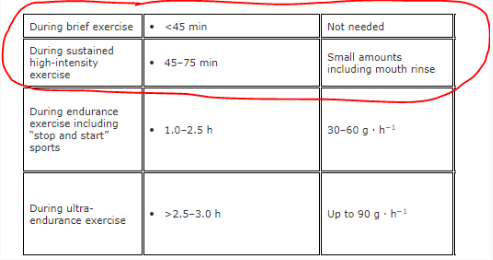
For cyclists participating in shorter activities or races, carbohydrate intake during exercise is therefore not always necessary. It is more important to focus on an adequate carbohydrate intake before exercise. Carbohydrate intake becomes increasingly important during longer events, when glycogen stores become more depleted.
References
- 1. Burke, L. M., Hawley, J. A., Wong, S. H. S., & Jeukendrup, A. E. (2011). Carbohydrates for training and competition. Journal of Sports Sciences, 29 Suppl 1, S17–27. https://doi.org/10.1080/02640414.2011.585473
- 2. Vitale, K., & Getzin, A. (2019). Nutrition and Supplement Update for the Endurance Athlete: Review and Recommendations. Nutrients, 11(6), 1289. https://doi.org/10.3390/nu11061289